Recently, the CPI-C team at the Nanjing Institute of Astronomical Optics, Technology and Astrophysics, Chinese Academy of Sciences (NIAOTA) has made important progress in the multi-band photometric inversion of exoplanetary physical properties, and the related paper has been published in the international astrophysical journal The Astronomical Journal (AJ 2026).
The Exoplanet Imaging Coronagraph (CPI-C; Fig. 1) is a distinctive instrument for the Chinese Space Station Telescope (CSST), with the capability to directly image cold exoplanets in the visible and near-infrared bands for the first time.
More than 6,000 exoplanets have now been discovered, but only about 40 exoplanets have been directly imaged; high-contrast imaging therefore remains challenging, because the planet-to-host-star intensity contrast can reach 10-6 to 10-10.
For the overall design of the CPI-C instrument, its high-contrast imaging approach, broadband multiwavelength photometric configuration, and scientific objectives, see Dou et al., RAA (2026); for the latest development progress and core science of CPI-C, see Dou et al., SPIE (2026).
CPI-C suppresses stellar diffraction and speckle noise through pupil modulation and precise control of wavefront aberrations, while its visible and near-infrared dual-channel cameras acquire planetary signals simultaneously over a broad wavelength range.
The study combines multi-band photometry of visible reflected light and near-infrared thermal emission, uses atmospheric models to systematically simulate the effects of molecular absorption by methane and other species, cloud coverage, and physical parameters, and provides systematic analytical methods and predictions for core scientific questions such as the planet's size and temperature, atmospheric composition, cloud state, and formation and evolution.
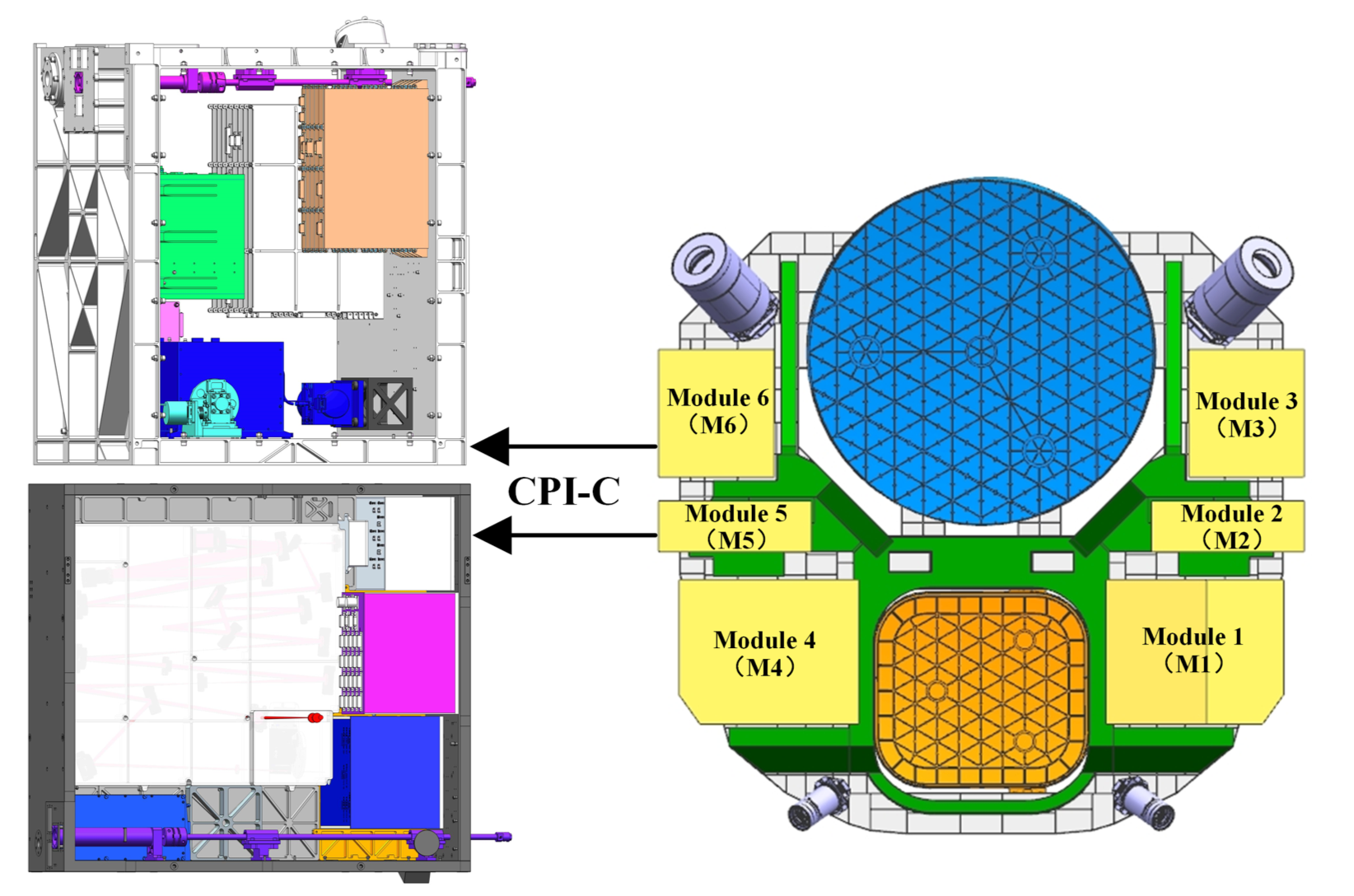
Figure 1. Schematic diagram of the CPI-C layout on CSST, with CPI-C located in the M5 and M6 envelope positions on CSST.
Visible and near-infrared observations provide two complementary types of information. For cooler, more evolved giant planets, the visible signal is dominated by starlight reflected from the planetary atmosphere. Methane is an important absorber in the atmospheres of cold giant planets, and the CPI-C visible photometric bands cover both relatively spectrally flat regions and methane-sensitive regions; by comparing the brightness differences among these bands, one can diagnose the shape of the reflected spectrum and constrain methane absorption, cloud state, and atmospheric heavy-element abundances.
Simulations show that increasing methane abundance produces systematic color variations among different visible bands, forming a recognizable distribution trend (Fig. 2).
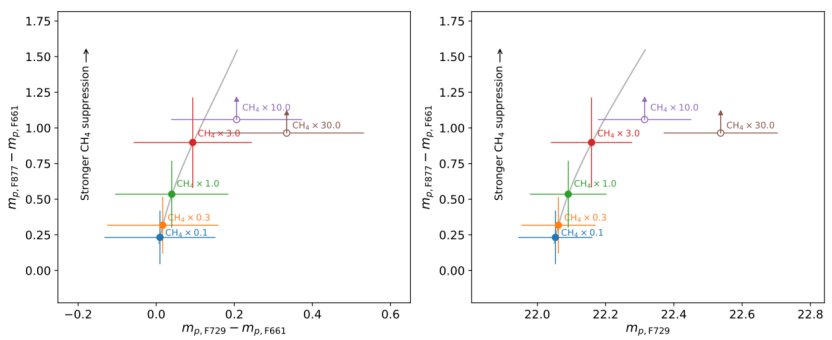
Fig. 2. Response of CPI-C visible-band multiband photometry to varying methane abundances.
Young or warmer giant planets retain significant internal heat and can produce thermal emission in the near-infrared. Variations in planetary brightness across different near-infrared bands are closely related to temperature, radius, surface gravity, and cloud properties.
By testing representative targets such as the HR 8799 multi-planet system and simulated planets, the team found that the four CPI-C near-infrared bands can effectively characterize the spectral energy distribution of thermal emission; combined with existing observations, they can narrow the possible ranges of parameters such as temperature, radius, and surface gravity, and estimate planetary mass under certain conditions.
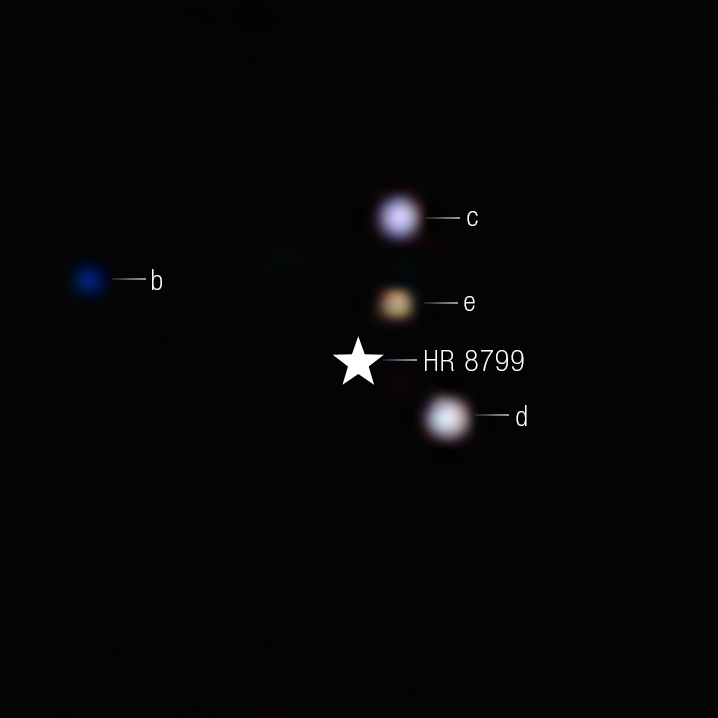
Fig. 3. The HR 8799 system contains four giant planets discovered by direct imaging and serves as a representative target for the near-infrared thermal emission analysis in this study, with the image showing JWST/NIRCam observational results.
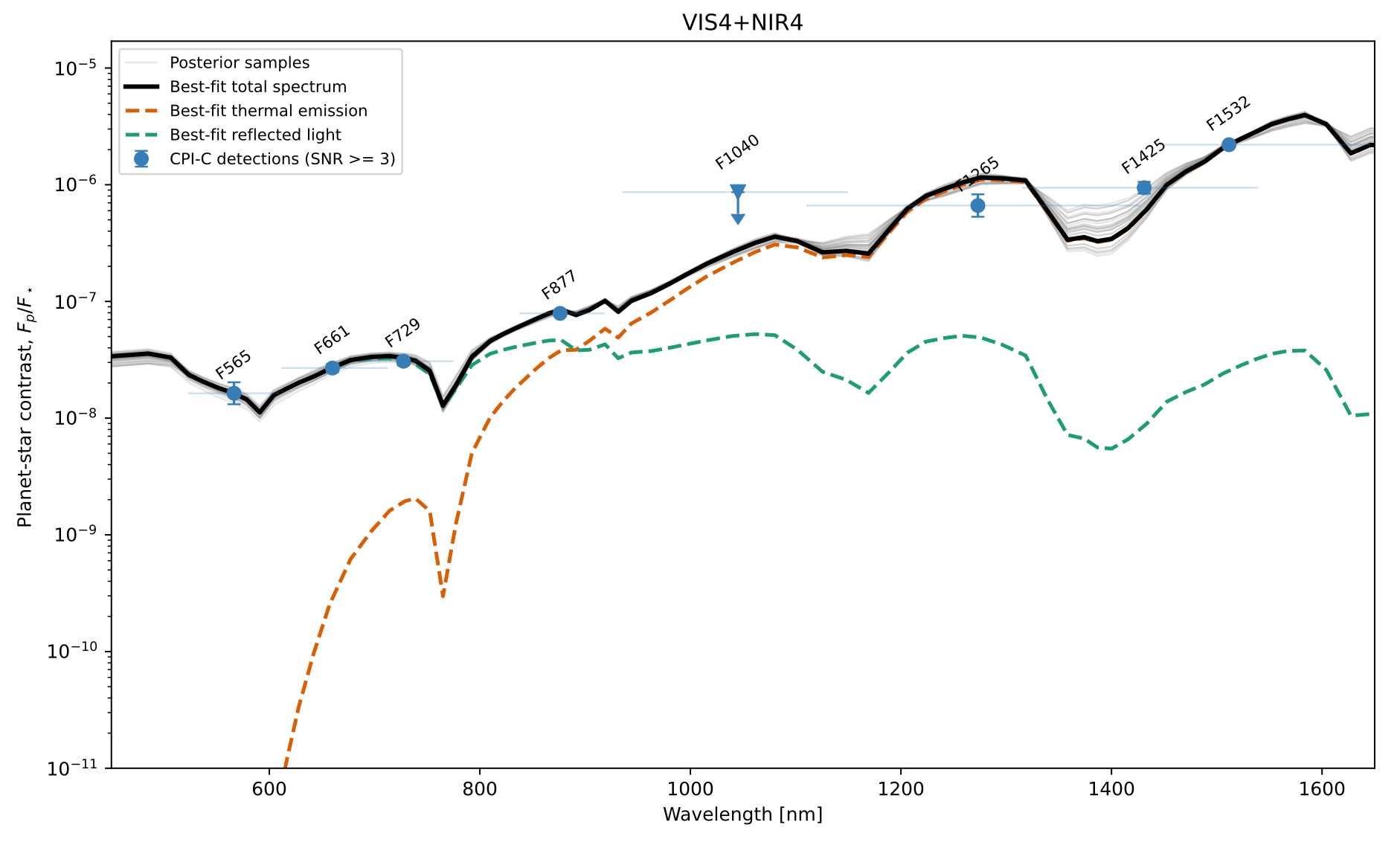
The team constructed a simulated giant planet and performed inversions using visible light, near-infrared, and the combined data, respectively.
The results show that combined observations yield a significantly more stable determination of planetary properties: visible light provides information on atmospheric reflection, whereas the near-infrared provides information on temperature and radiative state; the two complement each other, eliminating potential ambiguities in single-band analysis and significantly reducing uncertainties, particularly in the constraints on planetary radius and cloud properties (Fig. 4).
The study indicates that orbital location affects the strength of reflected light, residual starlight constrains the precision of faint-signal measurements, some strong absorption bands may not admit reliable detection, and future scientific returns will continue to depend on target selection, observing timing, starlight suppression capability, and data-processing level.
However, this study shifts the focus from “whether a planet can be seen” to “how much can be understood after detection,” establishing a complete analytical chain from atmospheric modeling and instrument simulation to parameter inversion.
Next-generation space missions will focus on imaging terrestrial planets and searching for exoplanet life signals, so that the ultimate goal of direct imaging will shift from giant planets toward “another living world.”
The multiwavelength observing capability of CPI-C opens a new window for understanding the atmospheric composition, cloud structure, and physical properties of giant planets, laying the foundation for China’s space-based exoplanet direct imaging and atmospheric characterization, and providing an important basis for humanity’s future search for and confirmation of a “second home” exoplanet.
The first author of the paper is Zhu Yiming; the corresponding authors are Zhao Gang and Dou Jiangpei; and the co-authors include Zhang Xi, Wang Gang, Lü Zhonghua, and Niu Bingli.
This science article follows closely the major CPI-C instrument paper, the March special-issue article in The Astrophysical Journal, and bridges the CPI-C instrument with distinctive exoplanet science returns.
Related References:
1: Zhu, Y., Zhao, G., Zhang, X., et al. Optical-Near-infrared Multiband Photometric Analysis and Characterization of Giant Exoplanets with CPI-C. The Astronomical Journal, 2026, 172, 212 (25 pp). https://doi.org/10.3847/1538-3881/ae9b04
2: Dou, J. P., Zhang, X., Zhao, G., et al. CPI-C: Cool Planet Imaging Coronagraph on Chinese Space Station Survey Telescope. Research in Astronomy and Astrophysics, 2026, 26, 055021 (27 pp). https://doi.org/10.1088/1674-4527/ae4a04
3: Dou, J. P., Wang, G., Zhu, Y. M., et al. The Progress and Core Science of the Cool Planet Imaging Coronagraph (CPI-C) on Chinese Space Station Survey Telescope (CSST). Proc. of SPIE, 2026, 14145, 141450Y. https://doi.org/10.1117/12.3103408


