The virtual imaging phase array (VIPA) spectrometer developed by the Astronomical Photonics Team at the Nanjing Institute of Astronomical Optics, Technology and Astrophysics, Chinese Academy of Sciences, has achieved an important breakthrough on the 1-meter New Vacuum Solar Telescope (NVST) at Yunnan Observatory—clearly resolving, for the first time in ground-based observations, the Si I 6560.57 Å line in the Hα band that has long been masked by atmospheric water-vapor lines, thereby demonstrating its distinctive technical advantages.
The related results have been published in the international academic journal The Astronomical Journal, Volume 172, Number 1.
The VIPA spectrometer employs a multimode fiber input with a core diameter of 25 μm and features a highly compact architecture.
Accurate wavelength calibration based on an astronomical frequency comb shows that the instrument achieves a spectral resolution of 290,000 to 340,000 over the wavelength range of 592.76–657.07 nm, covers approximately 816 VIPA diffraction orders, and can simultaneously record more than 650 solar feature lines in a single exposure.
Compared with conventional large echelle spectrographs, the VIPA spectrometer achieves an order-of-magnitude reduction in both volume and mass while maintaining an ultra-high spectral resolution.
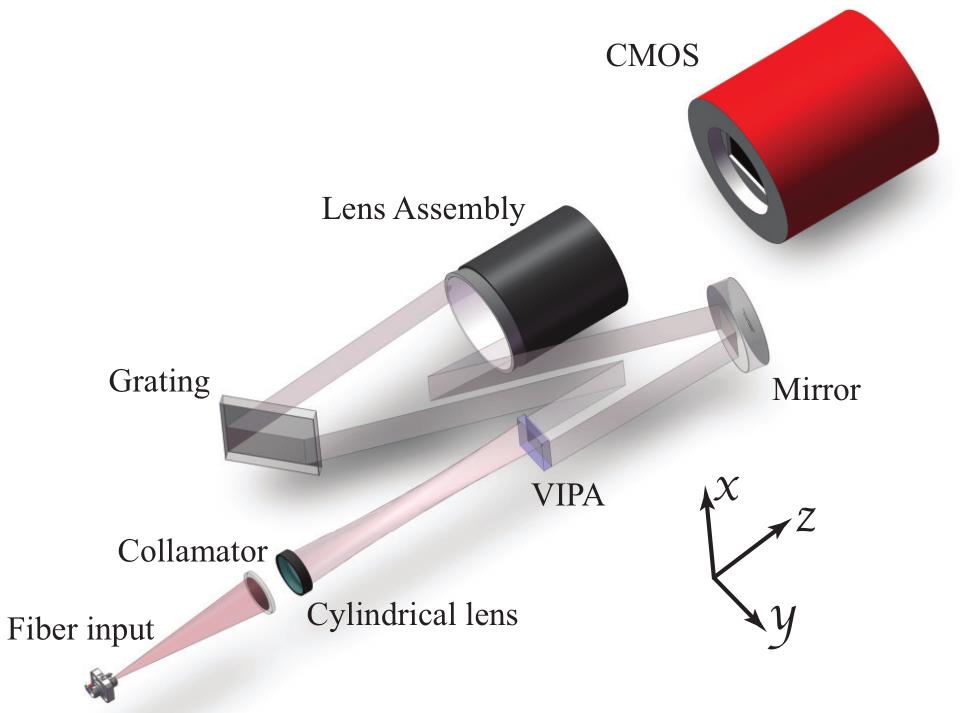
Optical layout of the spectrometer
Revealing the Physical Origin of the Asymmetric VIPA Instrumental Profile
The research team conducted a systematic performance characterization of the VIPA spectrometer using an astronomical frequency comb with a repetition rate of 25 GHz.
Experimental measurements revealed that the instrumental profile of the VIPA exhibits pronounced asymmetry that cannot be accurately described by conventional Gaussian functions.
The team elucidated the physical origin of this asymmetry through theoretical modeling.
To account for this property, the team proposed and adopted a Fano–Lorentz product function to fit the instrumental profile.
Compared with the Gaussian model, this function more accurately reproduces the asymmetric wing structure of the VIPA spectral lines.
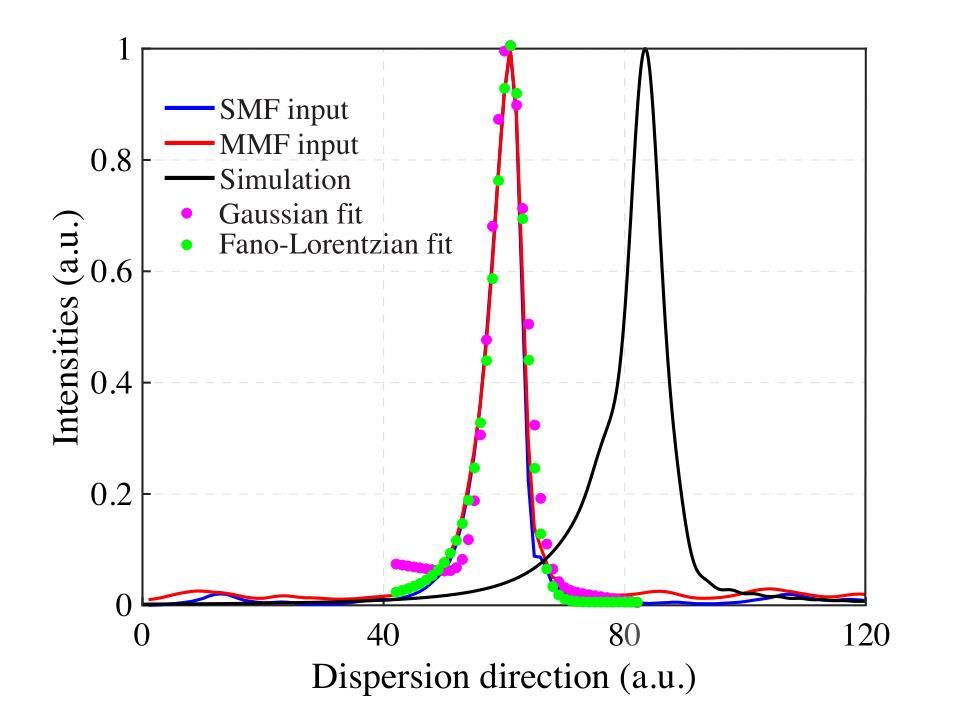
Comparison of the Spectrometer Instrumental Profile and Function-Fitting Results
The first ground-based detection of the Si I 6560.57 Å line in the Hα band is reported here.
The most striking result of this observation is that the VIPA spectrometer successfully resolved the neutral silicon line, Si I 6560.57 Å, in the far-blue wing of the Hα band at 6560.57 Å.
This line has long been blended with the terrestrial atmospheric H₂O absorption line at 6560.50 Å, and it is easily misidentified as a water-vapor line in routine ground-based spectroscopic observations; previously, it had been clearly resolved only by China’s Xihe (CHASE) satellite in an atmosphere-free space environment.
With its high spectral resolution of over 290,000, the VIPA spectrometer successfully resolved the two lines, which are separated by only about 0.07 Å.
Through spectral scans at the solar disk center, eastern limb, and western limb, the research team clearly observed the Doppler shifts of the Si I line caused by solar rotation: the western limb was redshifted by approximately 1.894 km/s relative to disk center, the eastern limb was blueshifted by approximately 1.875 km/s, while the terrestrial water-vapor line remained fixed.
This result not only achieved the first unambiguous ground-based identification of this weak photospheric line but also directly demonstrated the VIPA spectrometer’s capability to extract faint photospheric signals against a strong Hα chromospheric background.
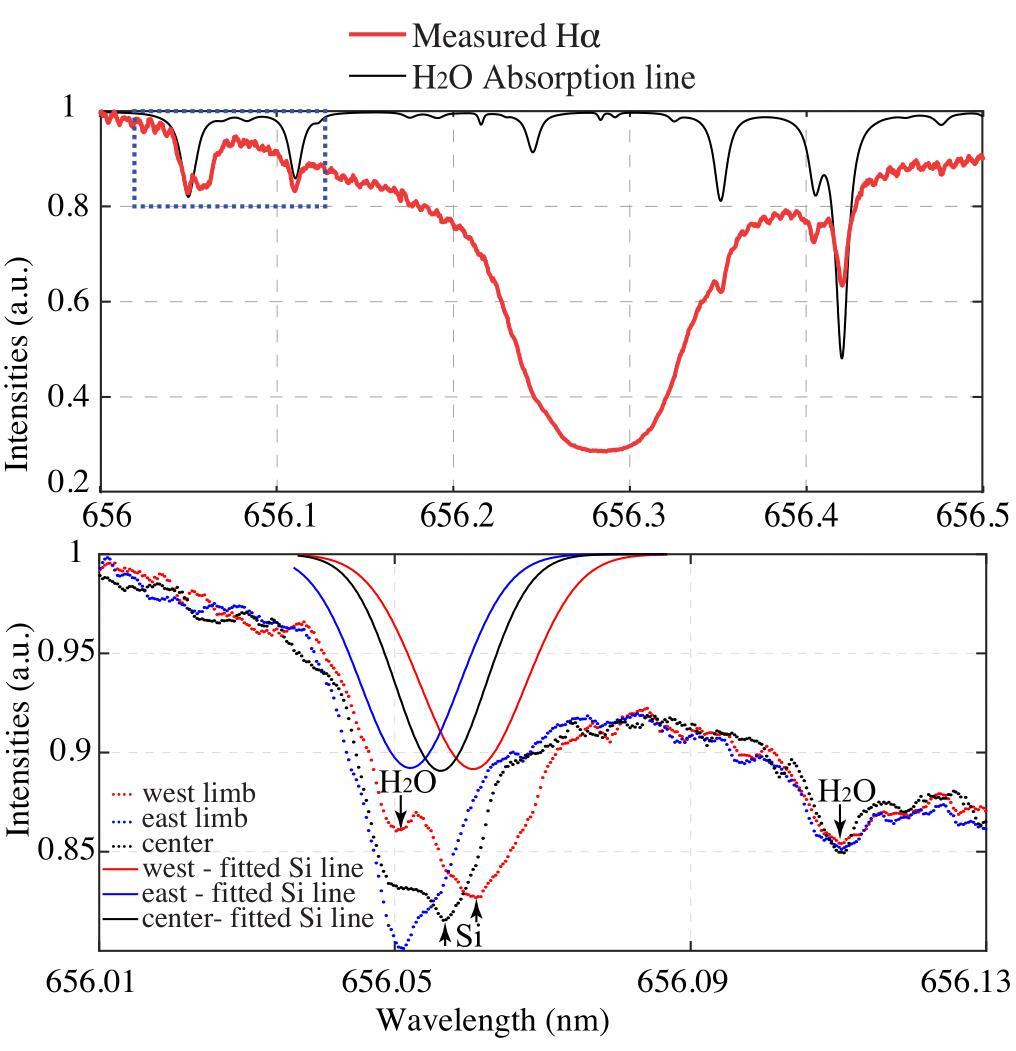
Si I Line Profiles in the Hα Band across Different Solar Disk Regions
Outlook: Toward a New Platform for High-Precision Solar Spectroscopic Observations
This successful observation marks a critical step for VIPA technology in the field of high-resolution solar spectroscopy.
The compact, lightweight, and high-resolution characteristics of the VIPA spectrometer make it not only suitable as a unique observing instrument for large solar telescopes, but also promising for future space-based solar observation platforms and simultaneous multi-object spectroscopy.
This research was supported by the National Natural Science Foundation of China, the National Key R&D Program of China, the Jiangsu Provincial Key R&D Program, and related funding from the Chinese Academy of Sciences.
Paper reference: https://iopscience.iop.org/article/10.3847/1538-3881/ae6fb1


