Recently, the coronagraph team led by Researcher Jiangpei Dou from the Nanjing Institute of Astronomical Optics and Technology, Chinese Academy of Sciences has made significant progress in the dynamical evolution of circumstellar debris disks.
Utilizing high-performance GPU-accelerated N-body simulations, the team has systematically demonstrated for the first time the decisive role of disk self-gravity in shaping warped debris disk structures.
This successfully accounts for the peculiar S-shaped structure observed in the debris disk around the young stellar system HD 110058. These findings were published in January 2026 in the prestigious astronomy journal Astrophysical Journal Letters.
Debris disks consist of remnant dust and planetesimals from planetary system formation, analogous to the asteroid belt and Kuiper belt in our solar system.
Observations reveal that many extrasolar debris disks exhibit pronounced asymmetric structures such as warps and eccentricities, often indicative of unseen planets in the system.
However, conventional dynamical models frequently neglect disk self-gravity in interpreting these structures, resulting in discrepancies between theoretical predictions and actual observations.
Addressing this issue, the research team from Nanjing Institute of Astronomical Optics and Technology conducted a case study on the warped debris disk system HD 110058, establishing a comprehensive debris disk model incorporating an inclined inner planet and numerous planetesimals.
N-body simulations revealed that gravitational interactions among disk materials suppress differential precession of the disk plane, inducing coherent rigid-body-like precession of the entire debris disk.
Under gravitational perturbations from the inclined planet, self-gravitating debris disks can develop pronounced warped structures within a short timescale (~0.5 Myr), which persist in a quasi-stable configuration over extended periods.
Synthetic scattered-light images from the simulations successfully reproduced the distinctive S-shaped warped features observed in HD 110058, providing strong support for the hypothesis of an undetected inclined planet within this system.
This study not only resolves the morphological puzzle of the HD 110058 system, but also underscores the necessity of incorporating disk self-gravity and mass in debris disk studies. It provides crucial dynamical insights for exoplanet searches using high-contrast imaging techniques.
Debris disks are key observational targets for the Chinese Space Station Telescope's Coronagraphic Planet Imager (CPI-C), with these findings establishing fundamental theoretical groundwork for CPI-C's target selection and specialized scientific investigations.
Paper title: "The Role of Self-Gravity in Debris Disk Warp Formation: The Case of HD 110058"
Full-text available: https://iopscience.iop.org/article/10.3847/2041-8213/ae2c72
The study's lead author is Associate Researcher Gang Zhao from Nanjing Institute of Astronomical Optics and Technology.
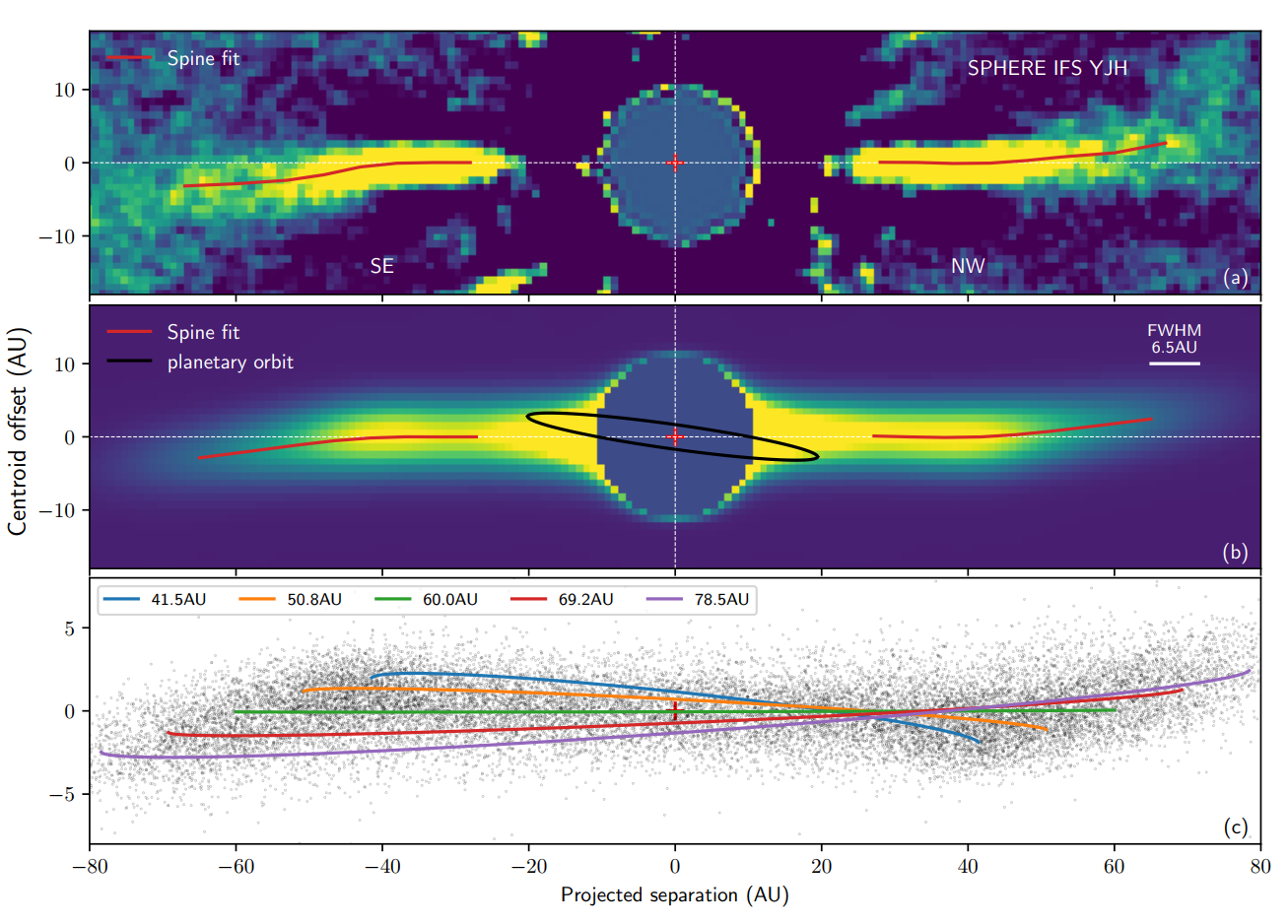
Upper panel: Debris disk structure of HD110058 observed by the SPHERE instrument on the VLT telescope. Middle panel: Synthetic scattered-light image derived from N-body simulation results. Lower panel: Planetesimal distribution obtained from the N-body simulation.


