Recently, the research team led by Dr. Jinping He from the Nanjing Institute of Astronomical Optics and Technology, Chinese Academy of Sciences, in collaboration with teams from the University of Hertfordshire (UK) led by Ben Burningham and the National Astronomical Observatory of Japan (including Yuka Fujii et al.), has systematically investigated the formation mechanisms of thermal radiation polarization signals in brown dwarf atmospheres using three-dimensional Monte Carlo radiative transfer simulations.
The study elucidates the unique advantages of polarization observations in characterizing cloud layers and thermal structures within brown dwarf atmospheres.
A novel methodology was developed to constrain the microphysical properties of atmospheric cloud particles in brown dwarfs through thermal radiation polarization analysis.
This approach provides fresh insights for addressing the persistent parameter degeneracy problem in this research domain. These findings were published in January 2026 in the internationally renowned astronomy journal Monthly Notices of the Royal Astronomical Society.
As explained by Dr. Fei Wang, the lead author of the study, brown dwarfs represent a class of substellar objects intermediate between stars and planets, whose atmospheres commonly feature cloud layers composed of silicates, metal oxides and other particulate matter.
These clouds significantly modulate brown dwarfs' spectral features, chromatic properties and photometric variability, serving as crucial determinants for understanding their atmospheric structure and evolutionary processes.
However, the strong degeneracy among cloud particle size, layer thickness and atmospheric thermal profile makes these parameters notoriously difficult to disentangle using conventional flux-based spectroscopic approaches.
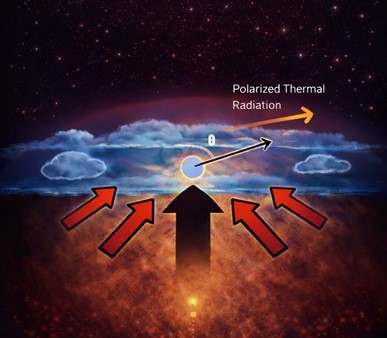
Figure 1. Schematic diagram of brown dwarf atmosphere and thermal radiation polarization
This study introduces thermal radiation polarimetric spectroscopy as a novel observational approach. Scattering of thermal radiation photons by cloud particles in brown dwarf atmospheres generates weak linear polarization signals.
The research team employed three-dimensional Monte Carlo radiative transfer simulations to systematically model polarization signals under various cloud particle parameters and thermal structure conditions, with particular focus on analyzing the effects of particle size distribution, cloud optical depth and atmospheric temperature gradient on polarization characteristics.
Figure 1 illustrates the distribution of cloud layers within brown dwarf atmospheres and the polarization mechanism resulting from thermal radiation scattering by cloud particles. Polarization characteristics exhibit strong dependence on particle size distribution, cloud optical depth, and atmospheric thermal profile.
Results demonstrate the superior sensitivity of thermal polarimetric spectra to particle size variations. Distinct peak structures emerge in the wavelength-dependent polarization degree within certain size ranges - features nearly undetectable in conventional flux spectra.
Meanwhile, cloud optical depth predominantly modulates the overall intensity of polarization signals, while the atmospheric thermal structure governs the spectral morphology of polarization as a function of wavelength.
Enhanced spectral features emerge near molecular absorption bands (e.g., water vapor), providing direct diagnostics of altitude-dependent temperature gradients.
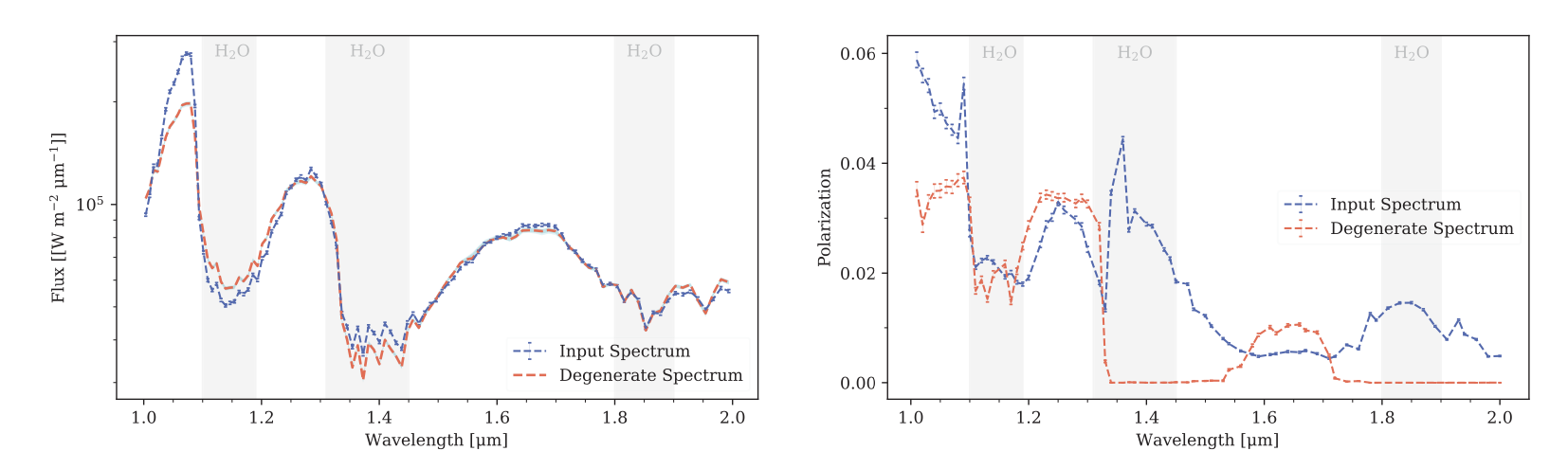
Figure 2 Polarimetric spectroscopy reveals atmospheric properties of brown dwarfs. Left panel: Similar flux spectra can be produced under different chemical abundances and temperature profiles. Right panel: Corresponding polarimetric spectra exhibit distinct variations within molecular absorption bands, demonstrating that polarimetric observations can effectively break model degeneracies in conventional spectroscopic analysis.
The study indicates that achieving polarization sensitivity at the 10-5 level in near-infrared (1-2 μm) observations would establish thermal radiation polarization as a powerful tool for characterizing cloud properties and thermal structures in brown dwarf atmospheres.
This methodology complements conventional spectroscopic observations, potentially mitigating uncertainties in atmospheric retrieval, thereby advancing our understanding of atmospheric physics in brown dwarfs and planetary-mass objects.
This study establishes a theoretical foundation for systematic integration of polarimetric spectroscopy in brown dwarf atmospheric studies, while providing valuable references for designing future high-precision polarimeters and defining their scientific objectives.
Full-text available at: https://doi.org/10.1093/mnras/staf2190


