From December 15 to 18, 2025, the Spanish GTC Observatory (GRANTECAN S.A.) convened an international review conference for the final design of the CHORUS (Canary Hybrid Optical high-Resolution Ultra-stable Spectrograph) in Tenerife, Canary Islands.
Distinguished attendees included Prof. Francesco Alfonso Pepe from the University of Geneva (Switzerland), Prof. Walter Seifert from Heidelberg University (Germany), and Spanish technical experts as review panelists.
Representing Spanish collaborating institutions were Prof. Eva Gloria Villaver Sobrino, Deputy Director of the Instituto de Astrofísica de Canarias (IAC), and Prof. Romano Corradi, Director of the GTC Observatory.
The National Astronomical Observatories of CAS and Nanjing Institute of Astronomical Optics & Technology dispatched a CHORUS project delegation (including three foreign specialists) to participate in the defense session.
During the session, the expert panel conducted in-depth inquiries regarding the reviewed final instrument design reports, technical drawings, and models.
The CHORUS project team delivered comprehensive presentations addressing scientific rationale, development plan, integration procedures, and project management aspects.
The panel unanimously approved the final design review of CHORUS, with IAC Director Valentín Juan Martínez Pillet attending to extend congratulations.
The CHORUS high-resolution ultra-stable spectrograph for GTC is a state-of-the-art scientific instrument jointly developed by the National Astronomical Observatories of CAS and Nanjing Institute of Astronomical Optics & Technology for Spain's 10.4-meter GTC optical telescope.
Featuring an innovative dual-band design, CHORUS will provide UV spectral detection capability for faint targets with R≥25,000 resolution, visible-light spectroscopy at R≥100,000, and high-precision radial velocity measurements, fostering Sino-Spanish collaborative research in cutting-edge areas including terrestrial exoplanet search, planetary atmospheric characterization, and galactic archaeology.
The project is supported by funding from CAS Major Scientific Research Equipment Development Program with the goal of enhancing China's innovation capacity and global influence in astronomical technology, while securing superior observational resources for Chinese astronomers.
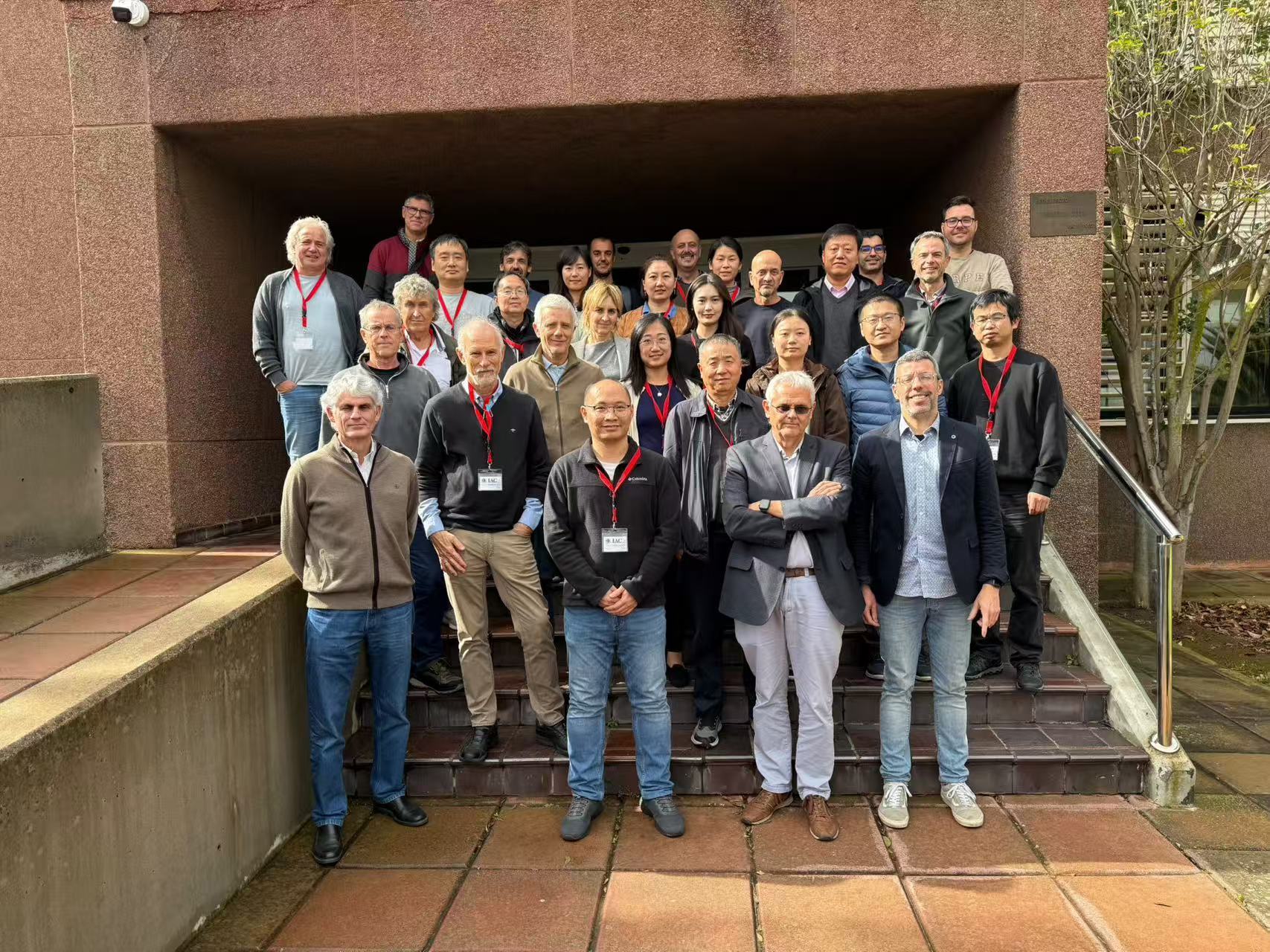
Group photo taken during the review meeting
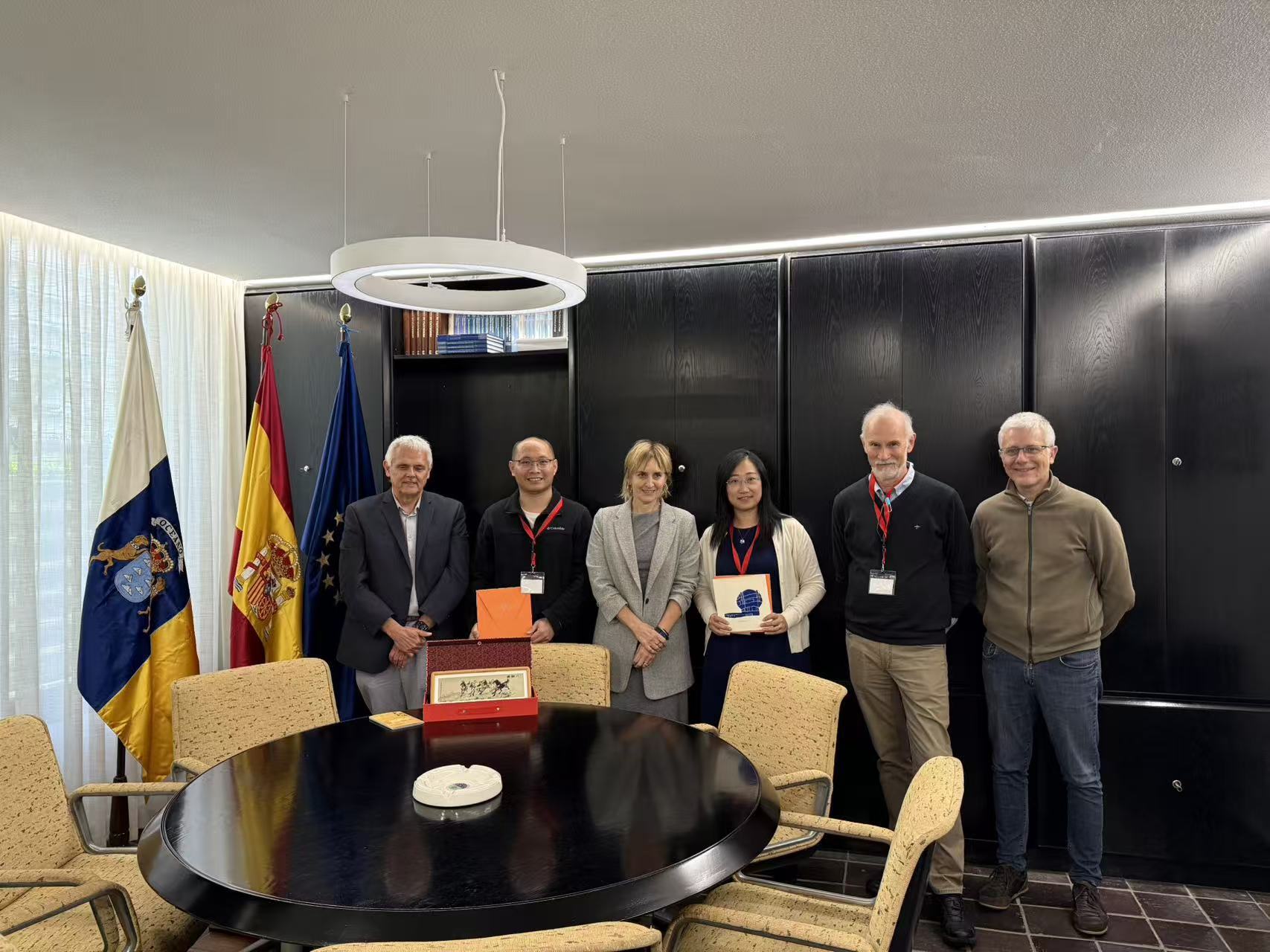
Prof. Valentine, Director of IAC (first from left), meets with representatives of the CHORUS project


